Uruguay has just made history once again. In October 2025, it became the first country in Latin America* to pass a law to legalise euthanasia. The passage of the law is really as an eye into Uruguayan society and politics. We also look at whether foreigners living in Uruguay can access the law’s provisions.
Obviously, it’s a deeply sensitive law and one that puts Uruguay on the same side as countries like Spain, Portugal, and the Netherlands where similar laws exist.
If you’re at all familiar with Uruguay, of course, this is not going to come as a surprise. Uruguay has been a pioneer in progressive legislation for over 100 years. And where most of Latin America is influenced by religious groups, here there has been complete separation of church and state since 1917. Plus you’re probably aware of the passing of progressive legislation such as marriage equality and marijuana legislation in the last couple of decades.
The BBC headline said: Uruguay legalises assisted dying after 10-hour debate. But let’s be clear. It’s more accurate to say: Uruguay legalises assisted dying after six-year debate.
The law that finally passed was a bill first proposed in 2019, which went through four versions. It went through stonewalling at committee level, was even archived last year and only recently re-opened. Uruguay may do radical things, but people take their time and generally work to come to a consensus.
Years of tireless campaigning for a Dying with Dignity law
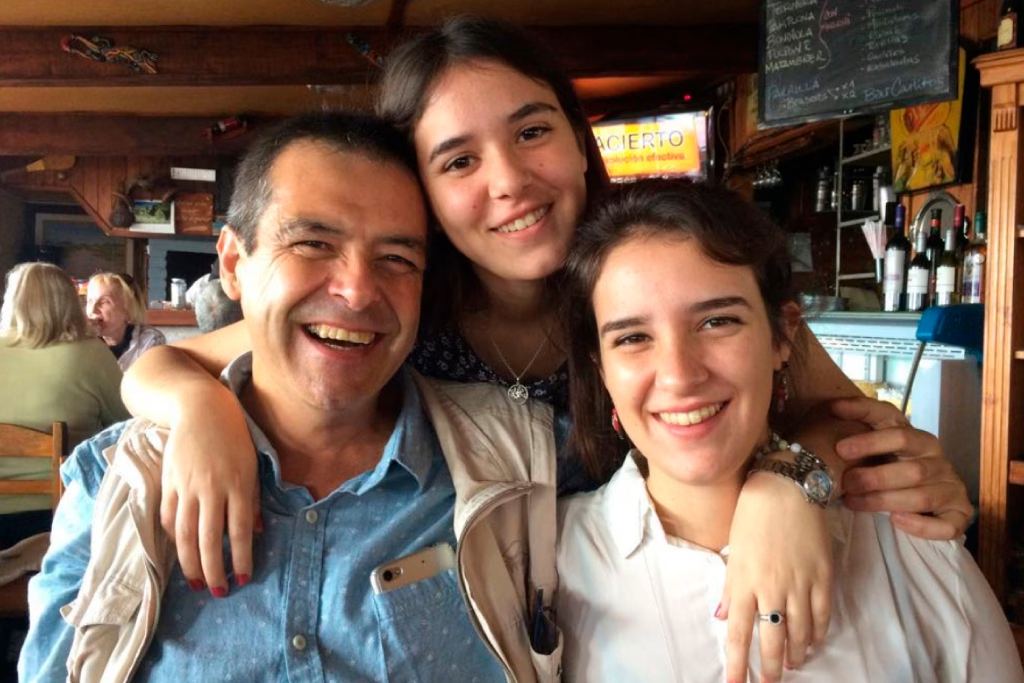
The most visible campaigner for the law is Florencia Salgueiro—in the BBC story photo, she’s in the orange shirt—, whose family lived through her dad’s diagnosis with ALS, an incurable motor neuron disease. Florencia was one of my son‘s best friends at primary school. We regularly met her mum and dad who were/are artists and ran a lovely workshop together teaching and producing beautiful ceramics.
Now 30 years old, Florencia has been a tireless campaigner following Pablo’s death in 2020. Imagine campaigning at the same time as grieving. The day the law passed, October 15, would have been Pablo’s 63rd birthday. Florencia called it a gift.
Perhaps what is striking about how Uruguay has chosen to frame the law is not simply as a medical or ethical issue, but as a question of human dignity and autonomy.
One of the law’s sponsors was quoted as saying “this is the freedom to choose. Those who want euthanasia can choose it and those who do not, can reject it”.
Guru’Guay talked to Florencia to learn more about the passage of the law—as an eye into Uruguayan society—and whether foreigners living in Uruguay can access the law’s provisions.
Some perspective on the passage of the Uruguay euthanasia bill for non-Uruguayans
The bill took six years to pass despite surveys showing that even many people with religious beliefs supported the measure. Alternative proposals, negotiations between political parties and the lack of consensus within some of the political parties themselves even led to the bill being archived last year.
So what’s the background? How did the political process work? Florencia shared with Guru’Guay.
In 2019 the ex-manager of the Uruguay Football Association Fernando Sureda, an indomitable character who was, like Florencia’s father suffering from ALS, reached out to a then senator, Ope Pasquet. There was a need for a law that would allow him and others in terminal situations to be able to choose to end their suffering. Ope took up the cause. He’s a member of the centre-right Colorado party. Liberal in the best sense of the word, Battlista.
A draft euthanasia bill was presented to Parliament for the first time in 2020—two days before the pandemic erupted.
Florencia‘s father had died a week later, so he knew political will was galvanising. In 2021 an inter-party group of young people from multiple different across the political spectrum came together to found Empatía Uruguay (empathy) to campaign for a euthanasia law. Having read Florencia’s Tweets around her family’s frustration regarding her father’s painful and protracted death, Empatía reached out to Florencia. Then just 26 years old, Florencia was already a professor in international relations, well-versed in legal documentation and a member of the progressive Frente Amplio. The FA was debating whether to support Ope’s bill or to offer an alternative. Florencia recalls writing the introduction to a revision of the bill, which was based on the careful language of the Uruguay’s right to abortion law (passed 2012), on her “crappy laptop“. Her introduction stands today in the brand-new law.
The bill passed the House of Representatives but encountered serious stone walling in the Senate. It needed to be reviewed by the Senate health committee, members of which were overwhelmingly anti-euthanasia. Treatment of the bill stalled. Until finally it was shelved in mid 2024—it’s assumed that key figures of the ruling party did not want such a bill passing in the run-up to the national elections in November 2024. The president had already implied that he would likely veto a euthanasia law (note, this was not simply the action of a conservative leader. Uruguay’s abortion bill was vetoed by the then progressive president, for personal religious reasons, contrary to the wishes—and votes—of his party. It was only passed under the next president). So inter-party conflict played a part. One senator who is stridently conservative, complained she had never come under such political pressure to archive a bill.
With a new government in power in 2025, the bill was unarchived and returned to the Senate for consideration. Interestingly, the original sponsor Ope Pasquet is no longer in government. However, he is a substitute (for a substitute for a substitute) of another Colorado senator, Robert Silva. Robert stepped aside in the Senate for the day of the debate to finally approve the bill—a warm gesture—so that Ope could present it.
Finally, the law was voted across party lines. Two-thirds of the Senate voted in favour.
A euthanasia law designed to prevent abuses
The law was written closely based on Uruguay’s abortion law using the language and safeguards as precedent to maximise its acceptability nationwide:
- The law is only open to adults who are citizens or have been living in Uruguay for at least one year (ie. does not need to be a legal resident).
- The person must be fully aware and consenting and suffering from a terminal illness with unbearable suffering or a condition that will deteriorate and affect the quality of life.
- The process isn’t immediate. At least two doctors need to corroborate the terminal circumstances. If there is disagreement, then a medical board including a psychiatrist and specialists must be consulted.
- After medical approval, there is a 10 day period for the person to reflect on their decision. Only then, and in the presence of two witnesses who do not stand to inherit, can the treatment take place.
- Assisted suicide is not part of this law.
More reading
Empatía Uruguay The civil society group which lobbied successfully for the euthanasia law in Uruguay.
The University of Uruguay has produced a podcast on euthanasia in Uruguay It’s called Caronte. “Caronte” translates to Charon in English, referring to the ferryman of the dead in Greek mythology who ferries souls across the river Styx. Find it on Spotify and soon on YouTube (in Spanish).
There’s a door there (film) Documentary based on conversations between Fernando Sureda, the inspiration behind the Uruguay euthanasia law and a Spanish palliative care expert. Watch the trailer with English subtitles.
Understanding Uruguay’s political parties A brief of main achievements, challenges and political characteristics over the last 50 years.
- Colombia and Ecuador courts have decriminalised euthanasia. However neither country has written laws regarding the practice.
Guru’Guay thanks Florencia Salgueiro for speaking to us and allowing use of the lovely family photo of her father and sister.