

Thinking of moving? The ultimate US vs Uruguay showdown

Looking south? US vs Uruguay compared: from healthcare to gun laws, to education to shopping, crime & community.
By Clara for Guru’Guay
US vs Uruguay
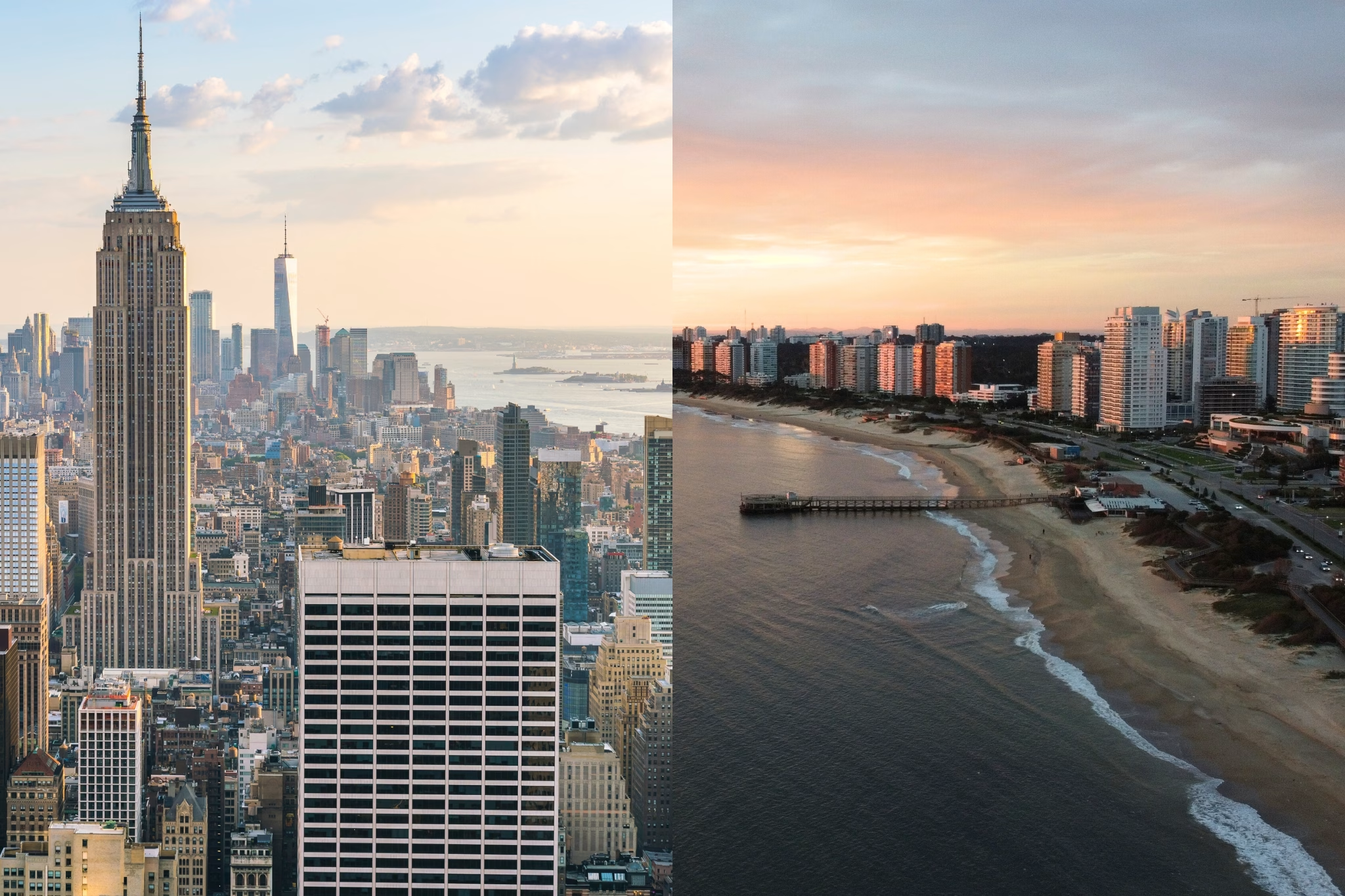
New York/Punta del Este
Last updated on April 25, 2025

Store

Find Guru’Guay products and services for your travel or relocation to Uruguay

Vacation

Relocation

[the_ad_group id=”331″]

At Guru’Guay, we’ve seen a massive—really, huuuuuge—surge in inquiries from Americans since the 2024 election results. Many progressives and liberals told us they no longer felt at home as the US shifted further to the far right. Luckily, in the US vs Uruguay comparison, Uruguay has always been a moderate country, no matter who is in power.

We put together this US vs Uruguay piece highlighting the differences between the two based on what stood out to our own clients, so readers can compare them at a glance. Whether you’re considering moving to Uruguay or simply curious about how it compares to the US, this breakdown shows what makes the country stand out—for better or worse.

Education

Education in Uruguay is secular, free, and compulsory, thanks to a law established in 1876. The school year in Uruguay traditionally runs from March to December instead of late August or early September through May or June like in the US.

School budget is not affected by the area the school is in, since education is ruled by ANEP, the National Administration of Public Education, an autonomous government entity. The average public school day is surprisingly short. Just four hours, but there is a logic behind this. It allows the same infrastructure and human resources to be used two or even three times a day.

There are no national exams or evaluations in Uruguay, so students just graduate high school and join university without any entrance test. Things such as SATs are unheard of, and student debt is nonexistent since public university is available to everyone.

Homeschooling is illegal in Uruguay. In 2024, the Uruguayan education authorities (ANEP) took legal action against a Mennonite community from the US which was homeschooling eleven children.

Technology in the classroom has been a major focus in education in Uruguay for decades. Private schools like this one can afford technology. But Uruguay’s Plan Ceibal has provided every school-age child with a portable device (computer or tablet) and an internet connection at their school since 2007. Photo courtesy of The Garzón School.

Healthcare

Uruguay has a universal healthcare system, meaning all residents have access to free or low-cost medical services through public providers. The system is funded by taxes and social security contributions, ensuring that even low-income individuals can receive care.

In contrast, the US relies heavily on private insurance making healthcare prohibitively expensive and leaving many uninsured or underinsured due to high costs. While the US boasts some of the world’s top medical facilities, access to these services often depends on your ability to pay, creating stark inequalities. In the US, even basic medical care, like COVID tests, can be costly, whereas in Uruguay, such services are more accessible.

Employment and jobs

The US is considered much easier for making money. You can earn significantly more, even in jobs like fast food, compared to Uruguay where salaries are lower, especially for professionals. Finding a job or even a paying gig is hard in Uruguay, even for skilled workers and university graduates, unless you’re in a highly demanded sector like healthcare or software.

However, there are more protected working conditions. The US has underlying issues when it comes to labor regulations like a lack of workers’ rights such as paid days off and maternity leave. Unions in Uruguay are strong and well organised and it isn’t surprising for certain workers like teachers or bus drivers to go on strike. In Uruguay you can’t be fired as easily as in the US and when you are, you might be entitled to financial compensation. Employees in Uruguay are entitled to 20 days paid holidays per year and two bonuses known as aguinaldo, one in July and one in December.

Crime

While Uruguay might appear rougher at first glance, it is generally safer in terms of violent crime compared to the US, where issues like school shootings are a concern. However, petty crimes like pickpocketing are more common in Uruguay. Uruguay is initially regarded as a “third world” country. However, people found it to be much nicer than expected, especially in areas like Carrasco and Punta del Este.

The capital of Uruguay, Montevideo, looks gritty due to the unkempt state of buildings covered in graffiti, yet this has nothing to do with gang violence and everything to do with bored teenagers having spray cans and markers. The writings on the walls are harmless and there’s even small artists like Un Tonga leaving uplifting messages on the streets of Montevideo. There is also a tradition of graffiti as an act of civil disobedience and political protest, as written by Uruguayan poet Eduardo Galeano.

Vaccinations

In the US, vaccination requirements can vary by state. All states mandate certain vaccinations for children to attend school, but the specific vaccines required and the exemptions allowed (medical, religious, or philosophical) differ.

In Uruguay vaccinations are mandatory and a matter of public safety. They are required for school entry and employment and even joining a sports centre. The country has a high vaccination coverage rate and the government provides vaccines free of charge. Uruguay controlled Covid-19 thanks to this community mindset, setting an example on how to deal with the pandemic without imposing lockdowns by relying on public awareness and solidarity.

Race and ethnic composition

Uruguay isn’t very diverse, with most of its population identifying as white (88%), while smaller groups report African (10.6%) or Indigenous (6.4%) ancestry. The country is racially cohesive, with most people sharing similar features like pale to tan skin, brown eyes, and brown hair. Black Uruguayans are a minority and Asian communities are almost nonexistent. Despite recent immigration waves, Uruguay remains largely homogeneous and the debate over whether Uruguayans consider themselves Latino continues, as many identify more with their European roots.

Race in Uruguay is viewed differently than in the US, partly because slavery was abolished early on in 1842 and apartheid was never part of the policy. Black Uruguayans, though marginalised, have a rich cultural presence, especially in Montevideo neighbourhoods like Barrio Sur, known for candombe. Terms like “negro” or “negrito” are used casually without the same stigma as in the US among friends, but discrimination persists affecting employment and income equality.

Shopping

In Uruguay, consumer goods like clothing and electronics are significantly more expensive than in the US costing up to double the price. This is attributed to import taxes, limited local competition and higher production costs. It may be tempting to look for alternatives, such as buying online from US retailers like Amazon or eBay.

However, shopping online from the US isn’t as straightforward in Uruguay. The country restricts you to only three small purchases per year from abroad, each under two hundred dollars. Even within these limits, shipping can be expensive and complicated, often requiring the use of courier services. Packages are frequently held up by customs, leading to delays and sometimes extra fees, so forget about online retail therapy—unless you’re buying from Uruguayan retailers!

Uruguay doesn’t have big box stores like Target or Walmart. You may have to hit more than one store to find what you need and shopping malls are few and far between. Even in Montevideo, you can’t find certain retailers and international brands like Zara and H&M don’t stock the same products they sell elsewhere. Luckily, Uruguayans like to dress casual so there’s no need to go out of your way and be fashionable.

Uruguay cost of living
Montevideo fair. Photo by Jimmy Baikovicius

Community

Uruguay has a “small town” mindset, with people being more close-knit but also sometimes more closed-minded compared to the more open-minded culture in places like New York, Boston or Seattle. Uruguayans are more touchy-feely than US Americans with a kiss on the cheek being the standard greeting —even when you’re meeting someone for the first time!

The US is seen as more individualistic, with people expected to move out and be independent at a younger age, whereas in Uruguay, it’s common to live with parents well into adulthood. High rent and a lack of university accommodation are contributing factors.

Paperwork

The US government systems are more streamlined, especially for things like immigration, where having a lawyer makes the process easier but expensive.

In Uruguay, government systems can be more bureaucratic and less user-friendly, especially for foreigners. You will need an escrow for transactions such as purchasing a vehicle or assigning someone power of attorney. To file your taxes you’ll need an accountant and the process is not done once a year in April like in the US but every month or every two months.

Gun regulations

Surprisingly Uruguay is the eighth most armed country in the world and most armed in Latin America, however gun laws are pretty tight and permits are issued after thorough evaluations, while concealed carry needs a special permit and is reserved for special circumstances. Also, gun culture is frowned upon by an important chunk of the population due to its associations with crime and the 1973 coup d’etat.

To acquire a gun in Uruguay, you need an authorization for the acquisition and possession of firearms (THATA). Civilians are only allowed to own smaller caliber firearms with no extended magazines. With the THATA you can own up to eight firearms. To be legally allowed to own more you must register as a collector. Once registered as a collector, there is no limit.

Voting

Voting in Uruguay is compulsory and the government is elected by direct proportional representation. There’s no such a thing as electors and gerrymandering, and all votes are cast the old fashioned way, with electronic ballots not being an option.

There is no electoral college and all votes cast by the citizens directly go to choosing the candidates and parties. Uruguayans are really engaged in politics and it is a widely discussed topic. There are more than 10 parties to vote for but more than eighty percent of the vote is split among three parties. Because this is Uruguay, all of the parties would be considered fairly moderate by international standards—with Uruguayans in general preferring moderation and continuity over radical change. Current president Yamandú Orsi is from the center-left Frente Amplio, while previous president Luis Lacalle Pou, was from the center-right National Party.

[the_ad_group id=”331″]

Latest

Namasté — Vegetarian restaurant in Montevideo

Namasté is more than just a vegetarian restaurant in Montevideo. This colourful, family-run spot has been serving vegetarian and vegan food since 2008. And the food is only part of the experience. Come for a relaxed meal, stay for the atmosphere, the friendly service and the chance to slow down for a while.


Tango dancing in Montevideo

Tango dancing in Montevideo

Dance tango in Uruguay. Whether a complete newbie or you already dance, the tango scene in Montevideo is a great way to make friends.

Popular

One Response

  1. Hola! I love your website. It has been a great help for me while I have been researching my visit recently to U and I am looking forward to moving in May from the US. Rocha is my first destination and I am very interested in starting a small business. Could you recommend anyone for me to contact in the La Paloma area for a vendor/food license product sales type of business once I obtain residency? Gracias, Laura

Leave a Reply

Your email address will not be published. Required fields are marked *

Related articles

Copy link