
Living in Punta del Diablo, Uruguay: A lesbian couple’s first year
Shelley and Chas moved from Georgia to Punta del Diablo, Uruguay. Real monthly costs, LGBTQ community, bringing cats, residency + advice.

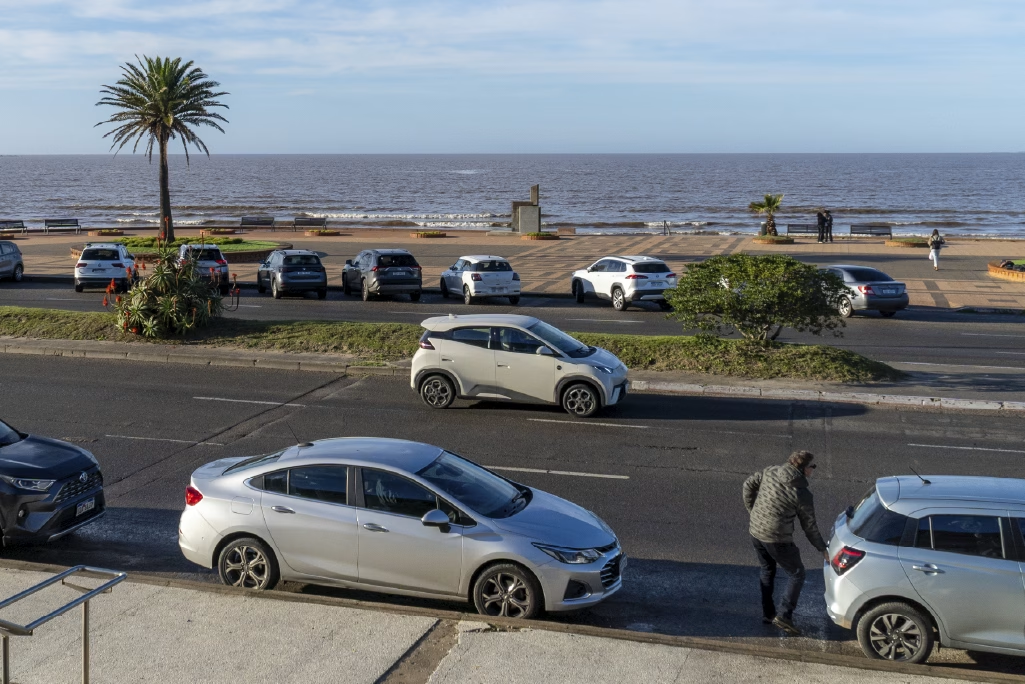
In May 2026, Uruguay hit a new green economy milestone. For the first time, more than four in every ten new cars sold in Uruguay that month were fully electric. For a country with no car industry of its own, no oil, and fewer people than many a European city, it is a remarkable turnaround. And one that I’ve noticed so many Guru’Guay readers outside of Uruguay are absolutely unaware of.

Uruguay’s rise to the top of the Latin American electric vehicles market did not happen by accident. It came from what local analysts have taken to calling a “perfect storm” — three forces pushing in the same direction at once.
The first is fuel. Uruguay imports essentially all of its petroleum, and taxes pile on top: the IMESI internal consumption tax and VAT together make up roughly half the price at the pump. The result is that a litre of regular petrol in Uruguay costs around two dollars and twenty cents — the most expensive in Latin America by a wide margin (where the average is 1.30 USD), and among the priciest in the world outside a handful of places like California and British Columbia.
The second is the grid. Uruguay generates around 97 percent of our electricity from renewables — wind, solar and hydro. So an electric car charged on the Uruguayan network is not just cheap to run. It is genuinely clean.
The third is policy. Since 2022 a government decree zeroed out the two main taxes that had held electric cars back: the IMESI (an internal consumption tax) was cut to zero for EVs, and so was the Tasa Global Arancelaria, the import tariff on vehicles, batteries, and chargers. Together they erased the price gap with petrol-run cars, and in the cheaper segments made them actually cheaper.
Many Uruguayan drivers are loving how cheap it is to run an EV. A woman interviewed by the BBC who drives an average of 100 kilometres a day recounted that her car fuel bill had gone down from 386 USD per month to just 51 USD. That’s a 87% reduction. Unsurprisingly, practically every ride-share driver has invested in an EV.
For most of the past decade the pioneer of Latin American electric mobility was Costa Rica. In 2025 Uruguay overtook it. According to the Latin American observatory ZEMO, around a fifth of all new cars sold in Uruguay in 2025 were EVs, more than double the share of the year before. Count plug-in hybrids too and the figure approaches thirty percent. The International Energy Agency recorded roughly 13,500 electric cars sold that year, against a total market of just over 60,000.
What is genuinely historic is not just the growth of electrics but what they are displacing. Uruguay became the first Latin American market where combustion-only sales are actually falling — down nearly fifteen percent between 2024 and 2026 even as the overall market grew about a quarter. Until now, EVs in the region had been additive growth on top of a still-rising petrol market. In Uruguay, the electric revolution is starting to replace petrol and diesel.
There is a catch though. The boom is in new sales. Of the entire vehicle fleet on Uruguayan roads — roughly two and a half million cars and light vehicles — only around 30,000 are electric, somewhere between one and two percent of the total. The replacement of the existing cars has barely begun.
The clearest way to see what Uruguay has achieved is to look at other countries, right?
In Norway, the world leader, about 97 percent of new car sales in 2025 were electric, and the country’s EV fleet has since crossed the one-million mark. In Germany, around a third of new cars were electric. The European Union as a whole averaged about a quarter. The United Kingdom reached roughly a quarter electric, or about a third counting plug-in hybrids too. The United States sat at around seven or eight percent — and that figure fell sharply in the last quarter of 2025 once federal EV subsidies expired in September, dropping below six percent.
So Uruguay’s 2025 EV result — about a fifth battery-electric — was nearly three times the US rate, and by mid-2026 its monthly share was exceeding the annual rates of Germany and the UK.
Norway remains in a league of its own, but Uruguay is now closer to the European front-runners than to its Latin American neighbours. Argentina, by contrast, sold fewer than a thousand electric cars a quarter in 2025.

If you are buying a car in Uruguay today, the electric vehicle market is, in effect, a Chinese market. BYD Uruguay is the undisputed leader, though its dominance has slipped from a near-monopoly of around 70 percent in 2024 to roughly a quarter of monthly sales as rivals have flooded in.
The ranking runs BYD first, with models like the Yuan Pro, Seagull, Dolphin, Yuan Plus, Seal, and Han; then Dongfeng with its Nammi city car; Geely with the EX5 and Geometry; Chevrolet with the Spark EUV and Captiva EV; Renault with the Kwid E-Tech; and Wuling with the Binguo. At the premium end, Volvo‘s EX30 Core and the German luxury brands — Mercedes-Benz, BMW, Audi — are also present.
Prices cluster into clear tiers. The entry city cars — the BYD Seagull, Wuling Binguo, Geely Geometry, Renault Kwid E-Tech — come in under about 25,000 dollars. Mass-market electrics like the BYD Dolphin, BYD Yuan Plus, Geely Geometry C, and Volvo EX30 Core sit roughly between 29,000 and 39,000 dollars. Premium models — the BYD Seal, BYD Han, and now Tesla — start around 33,000 and climb past 50,000. The luxury German electrics top the market above 45,000.
The price point that tipped the market was the cheap end and that was achievable only because of the zero-tax regime.
The big story of EVs in Uruguay came on July 9: Tesla Uruguay officially announced its arrival. Elon Musk flagged it in a social post, and within days the company’s Uruguayan website was taking orders. Tesla sold roughly 200 cars on its first day.
The process had been months in the making — trademark registrations in January, the hunt for a Montevideo general manager in April, the incorporation of Tesla Uruguay SAS, and the homologation of the Model 3 and Model Y with the Uruguayan energy regulator. Tesla, which always sells direct without franchise dealers, called the move “a new milestone in the plan of expansion through Latin America,” following its launch in Colombia the previous November.
The Tesla Uruguay prices are low enough to disrupt a Chinese-dominated market: the Model 3 starts at about 33,000 dollars, the premium version at 38,000, and the Performance at 50,000. Tesla is also evaluating a network of superchargers across the country, consistent with its strategy of building proprietary fast-charging infrastructure alongside its commercial entry.
Tesla’s arrival landed, by timing or coincidence, exactly a week after the Orsi government made a decision that will shape the next chapter of the electric vehicles Uruguay story: it is bringing back the IMESI on EVs.
Since 2022, EVs have paid zero IMESI — the single most powerful incentive in the system. On July 1 2026, the government signed a decree reinstating the tax from January 1 2027. Crucially, the new regime is tiered by import value, designed to shield the cheap city cars that have driven mass adoption while clawing back revenue from the premium end.
The cheapest EVs — up to about 19,000 dollars of import value — stay exempt. That covers the BYD entry models, the BYD Dolphin, the Wuling Binguo, the Geely Geometry, and the Renault Kwid E-Tech. A middle band, from 19,000 to 27,000 dollars, will pay a five percent IMESI, adding roughly 1,800 dollars to models like the BYD Dolphin Plus, BYD Yuan Plus, Geely Geometry C, and Volvo EX30 Core. Above 27,000 dollars, the rate rises to nine percent — about 4,500 dollars extra — hitting the BYD Seal, BYD Han, and Tesla Model 3 and Model Y. The German luxury EVs sit at the most affected end. Hybrids face a separate schedule.
The government’s argument is that the market has matured and no longer needs the full incentive package; the industry, led by the Automotive Trade Association (ACAU), argues the opposite — that with electrics still only a sliver of the total fleet, the real substitution has barely begun. There is also a predictable behavioural effect: with the change announced six months in advance, buyers considering a premium EV are rushing to close deals before January 2027, producing an anticipatory spike in demand. The import tariff, the TGA, remains at zero for now, so the change is partial, not a full reversal.

If the Uruguayan model has an Achilles heel, it is charging. The electric fleet is growing far faster than the public network, and people I talk to, especially those living in apartments in the capital complain about too few public charging points for the cars now on the road.
The response is being led by UTE, the state electricity company. UTE has been expanding the national charging network with the explicit aim of placing stations an average of fifty kilometres apart across the country, so a driver is never far from a charge. It is now planning a further rollout to keep pace with EV numbers, and Tesla’s potential supercharger network adds a complementary fast-charging layer on top.
Even better, EV recharging is improving. The first waves of EVs in Uruguay — small Chinese city cars like the BYD Seagull and Wuling Binguo — were built largely for slow AC charging, typically taking four to five hours for a full charge from a standard outlet. The newer models now entering the market — the BYD Yuan Plus and Yuan Pro, the Geely EX5, and crucially the Tesla Model 3 and Model Y — support DC fast charging so you can full charge in roughly thirty minutes at a compatible station.
The part of the electric car story that worries a lot of us is what happens when the batteries die.
Lithium-ion batteries contain lithium, cobalt, and nickel — materials whose extraction carries its own environmental cost, and which become a hazardous waste problem if dumped at end of life.
In Uruguay, the concern is acute for a different reason: every battery on the road today will one day need a disposal route that does not yet exist at scale.
The legislation is already in place. Uruguay has approved a decree establishing an Extended Producer Responsibility system for batteries. Importers will be required to take back and manage the batteries they put on the market, with the system becoming mandatory in 2027. The financing mechanism is already defined: a trust fund (fideicomiso) into which a small contribution is paid at the point of sale, so that, as ACAU’s executive director Ignacio Paz put it, “the final disposal is already paid for from the start.”
The decree offers two routes for the batteries themselves: export them to countries with the specialist recycling technology, principally China, where lithium, cobalt, and nickel can be separated for reuse; or recycle them domestically.
A Uruguayan company, Werba, already operates what it describes as unique-in-South-America equipment for the safe discharge and treatment of lithium batteries. In parallel, a research team at the University of the Republic (Udelar) has been working since 2023 on direct recycling methods for end-of-life EV batteries, looking at physical-chemical separation techniques including one called “flotation.”
So while the batteries rolling out under today’s new electric vehicles in Uruguay will not need disposal for years, the legal and financial architecture to handle them appears to be being built. Does this place Uruguay ahead of several far richer countries still wrestling with the same question? (Feel free to comment below)
The Uruguayan story is almost a controlled experiment. Take a country with no car industry, expensive imported fuel, a near-clean grid and a government willing to zero out taxes on a new technology — and watch what happens.
So far, a fifth of the new car market went electric in 2025, more than four in ten by mid-2026 and the first real retreat of the combustion engine anywhere in Latin America.
The next test will come in 2027, when the IMESI return and the battery rules take effect. If Uruguayans continue to buy those money-saving entry-level EVs (I don’t see why they won’t) and the premium segment absorbs the tax, Uruguay will have shown something genuinely valuable: that a country can graduate from heavy-handed incentives to a more neutral regime without killing the transition.
Living in Punta del Diablo, Uruguay: A lesbian couple’s first year
Shelley and Chas moved from Georgia to Punta del Diablo, Uruguay. Real monthly costs, LGBTQ community, bringing cats, residency + advice.

Carolina Sprengel Real Estate – Investing & selling
Investing in Uruguay real estate or selling your property? We love this realtor for sharp financial analysis and honest, hands-on service.

Alto de la Ballena – Pioneering Maldonado winery
Tiny Maldonado winery producing some of Uruguay’s finest wines. Alto de la Ballena was the first to make wine in Uruguay’s top wine region.

Casa Mara Uruguay – Designer hillside hideaway
Casa Mara Uruguay: a sierra hillside hideaway with three cabins, a natural infinity pool and not a single power line in sight.

Uruguay – most gay friendly nation in South America
…and 3rd friendliest in the world according to Equaldex. Homosexuality has been legal here almost 100 years.

Montevideo Carnival 2027 dates
Hot off the press! The world’s longest carnival is in Montevideo Uruguay and we’ve got the dates.

Treehouse Ecolodge – La Barra eco-hotel
Your treehouse perched in a pine-forest 2 minutes from the beach. The most unique La Barra hotel experience ever.

Baco – Montevideo’s top wine restaurant
A French bistro with probably the longest wine list in the city and multiple by-the-glass choices is one of the best Montevideo restaurants.

Namasté — Vegetarian restaurant in Montevideo
Looking for vegetarian restaurants in Montevideo? Namasté is a family-run restaurant serving home-style food in a relaxed, colourful setting.

Dance tango in Uruguay. Whether a complete newbie or you already dance, the tango scene in Montevideo is a great way to make friends.

Shelley and Chas moved from Georgia to Punta del Diablo, Uruguay. Real monthly costs, LGBTQ community, bringing cats, residency + advice.

We interview foreigners in Uruguay who moved here from principally English-speaking countries so you can learn from their mistakes.

Magnus shares the reality of off-grid living in Uruguay: dodgy container homes, growing food, healthcare, education & the need for serious savings.

People regularly ask me if many Americans are moving to Uruguay and they’re always shocked at the numbers.

Living in Uruguay beach towns offers a slower lifestyle and affordable living. Ann and her partner left the US to start living in Uruguay.

We perused Reddit to find foreigners’ most asked questions about Uruguay and answer so you can decide if Uruguay is the Plan B you’re looking for.